Friday, 9 May 2014

Expletives galore and got a date

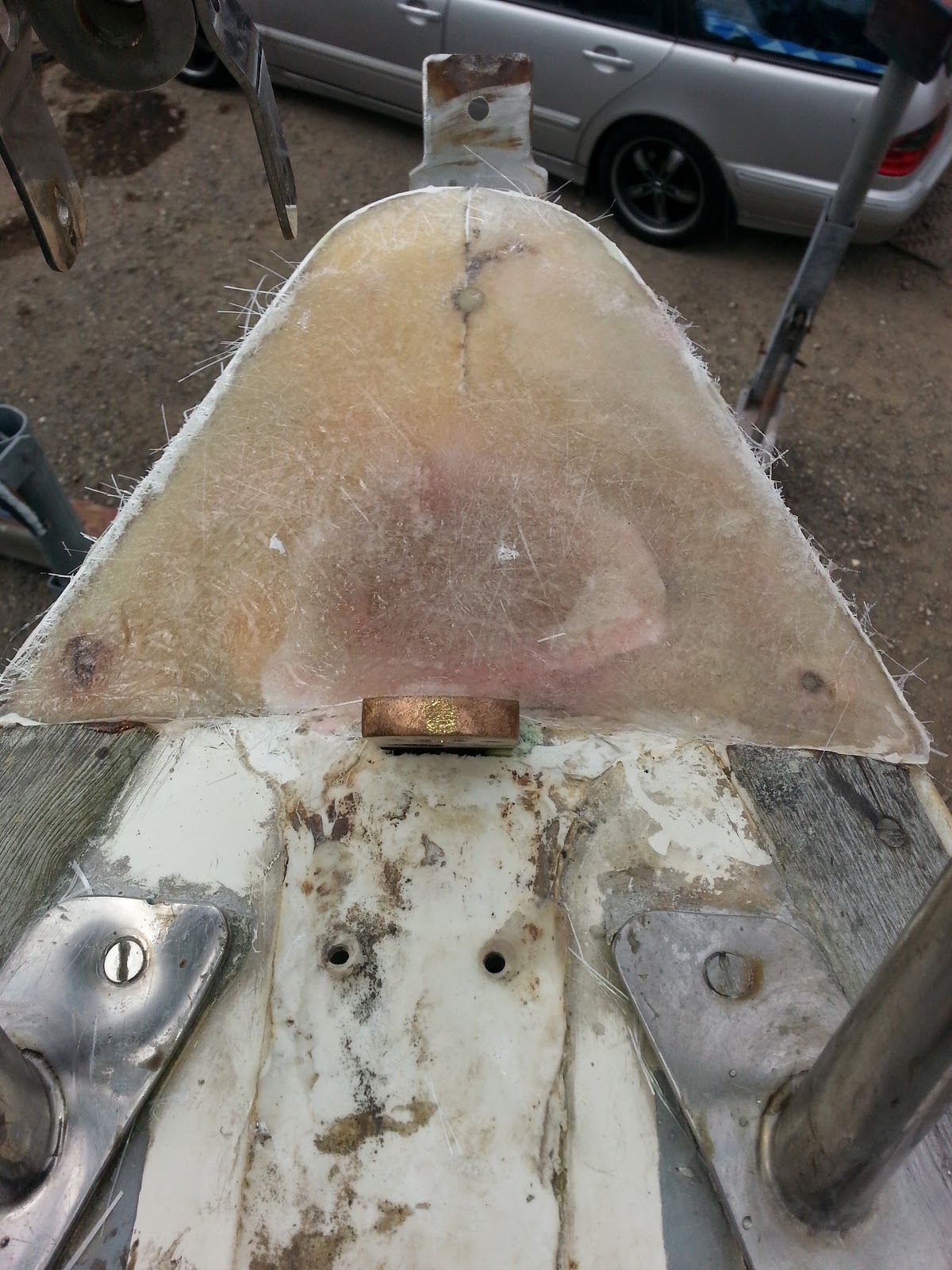
Last weekend with a lot of help from Chris and under his guidance I finally managed to construct this plug from which I hope Mike the foundry man will be able to cast a bronze fitting for connecting the rudder shaft to the new tiller (shortly to be made by Paul of 'Oflandandsea' on eBay:


The two halves will be used to create impressions in sand into which the molten bronze will be poured. Somehow they will be able to produce one solid bronze version of the above but only after I have done some more more work.

It took me almost the entire weekend to produce the above - hence the reference to expletives of which there were plenty - and (wrongly as it turned out) a solid inner plug for the hole. As Mike pointed out he needs a hollow version of that not a solid one. I haven't yet got my head around how he will use the eventual three pieces to cast the final object and have to visit him again for tuition on further modifications to be made to the above too before he can use it. I hope that doesn't take up another precious weekend.

I've now booked a slot with the marina to lift AS back in on 2nd June. With a couple of days off work, less (as it were) a Saturday that I'm required at home to celebrate my Grand daughters (twins) birthday, that means I have about 8 days to:

  • Install the new rudder shoe (that Mike will make soon I hope)
  • Re-fit the prop plus related anodes
  • Fill the old anode holes in the hull (removing this completely because it looks like it may have contributed to the corruption and poor performance of the Verometal anti-fouling.
  • Fit new transducers for Log and Echo-sounder (which will require removing the flexible water tank somehow)
  • Final tightening of the new chain plates
  • Re-antifoul with the replacement Verometal
  • Clean and wax/polish the hull
  • Service the sea cocks
  • Replace Galley hull skin fitting but note below
The other jobs I'm probably going to pass on are:

  • Stern gland stuffing box - I'll give it another go if I have the time but I haven't been able to shift the bloody thing, but I have pumped grease all the way through until it comes out the stern tube without coming out of the gland stuffing box, so I'm concluding that will keep the water ingress down to acceptable levels
  • Lightening conductor only needs the water tank out rather than the boat on dry land
  • Not going to fit a clever fridge so only need to replace galley skin fitting with like for like (that will then mean all skin fittings have been replaced).

Also, while it's not an out-of the-water job, the fact that I've clearly not got any sailing in yet (and will have very little sailing time this summer anyway due to work and domestic commitments) it looks like I will postpone the fitting of the 2 x 100 W solar panels that have been sitting at home for 15 months already) until next year!

An extra in-water job to add to the previous list is to ensure that the electrical circuits are not aggravating the electrolysis reactions which seem to have buggered up the previous Verometal anti fouling. I hope to draft Mick in for that and a number of other electrical jobs.


Tuesday, 29 April 2014

Bow made good, footless and wheeless

Having installed the new chain plate on the bow the next job was to make good the ugly mess I had created when removing the old one. I tackled that a couple of weeks ago on the 18th April.

First I had to remove the plastic bag covering the hole which previously I had filled with expanding foam. That stuff is very useful but horrid to work with it sticks to everything and is impossible to get off one's skin once it has set which it does very quickly. It had continued to expand after taping on the plastic bag so there was a lot of excess to remove. Fortunately it is very easy to cut one dry and so that was achieved quickly.

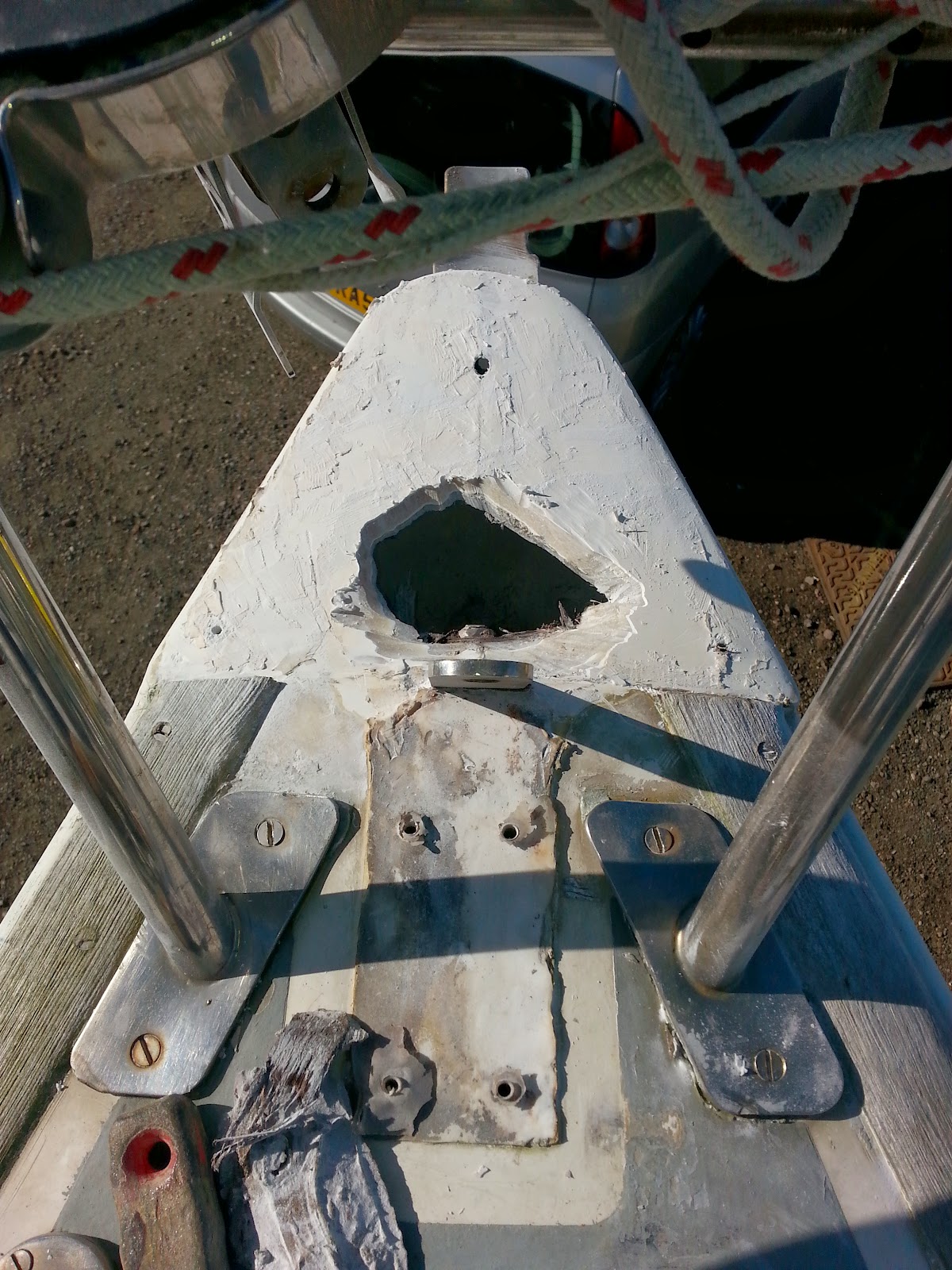
Next I had to insert a a plastic gasket over the top of the foam because the resin that I would use to make good the bow would dissolve the foam. I used a section of a Jeckell's sail bag and stuck it in place with marine sealant. Then a few layers of fibre glass resin and matting until it looked like this:


I got the mixture slightly wrong and so the resin dried to quickly but I just got away with it. Then resin mixed with particles until it formed a think paste and applied that which ended up looking like this:


Once that had dried liberal helping of marine sealant before fitting the metal work. Tightening up the four machine screws holding the rear plate on in the picture below was the worst part of the job. Luckily Alan was around and he therefore held the tops of the screws whilst I hung upside down in the anchor locker and tightened the nuts on the inside. My back was very sore for a number of days afterwards.


The next day - once again with Alan's help I fitted the stern chain plate permanently and was then able to refit the backstay, forestay and furling gear. That took a few hours. Fitting roller furling gear is a fiddly job - at least I find it so. Despite re-reading the instructions a number of times I couldn't work out how to keep the foil in place in order to insert the various screws. I resorted to a bit of tape that just about did the job. Once I had finished I discovered the grub screw for that purpose! Anyway I got it all back together as you can see from the photo below and despite the boat still being stuck  firmly on dry land, it started to feel a bit more like a boat again. I haven't transferred the shrouds to the new chain plates yet - that can wait until the boat is back in the water.


I took the week off after Easter and was back at the boat on the Tuesday and Wednesday.

First job with Chris's help was to remove the outer prop bearing casing. This we managed but instead of the expected cutless bearing Chris discovered it was a white metal bearing. This apparently is poured in place in liquid for (having previously ensured plenty of grease to prevent the white metal boding with the shaft. However Chris also diagnosed significant wear on the prop shaft and concluded there would be no point in replacing the bearing without also replacing the prop shaft! Happily because the stern gland did not leak significantly and he also concluded that it would be OK to refit the external bearing but be prepared to have to replace the whole shaft at some point in the future. No doubt the engine will have to come out too at some point so I'll probably do both together.

I had also previously noticed that one of the bolts holding the rudder shoe in place looked rusty and so needed to check that out. I consulted Chris once again and he recommended that I took the shoe right off to check it out thoroughly. The last thing I wanted was the rudder failing mid Atlantic!


I put a spanner on the nut expecting to have a real fight to move it but the nut just fell off. It had actually corroded right through.


 That's it on the cradle in the photo below.


The bolt was also severely corroded at the tip.


 The other nut and bolt was at least still intact but it too was severely corroded.


Wit both bolts removed I was able to remove the shoe.


Unfortunately I didn't take a photo of it. On initial inspection it didn't appear to be in bad shape but Chris spotted crevice corrosion and indeed once cleaned up it was very evident. Chris recommended getting a new one cast in bronze and he immediately set about making a plug to go with the shoe to the foundry. A quick search on the internet (by Alan of all people) and a local address was located in Rochester only a few minutes away from Howard's house. I rang them up and spoke to Mike and arranged to take the shoe and plug round the next day. His foundry is actually in Charlton however.

I spent the rest of the day cleaning up the shoe and bonding plywood strips to the outside in order to ensure a thicker casting was produced. They weren't completely flat so I decided to use marine sealant/bonding gunge for the purpose and hoped that it would set over night so that I could clean it up and ensure all the surfaces were smooth. It did thankfully and in the morning I completed preparing the shoe and took it and the plug that Chris had made over to Mike, the Foundry man in Rochester. I said he could do the job and so I left it with him to price up.

On the way back I stopped off at Howard's for a coffee and natter and once back at the boat decided I would tackle the stuffing boxes on the rudder and propshaft. Both were pretty inaccessible but I had previously managed to move the nuts on the rudder one and so decided to look at the prop-shaft one first. Some weeks ago I had discovered a small inspection hole cut out of the quarter berth bulkhead that I thought must have been made for the purpose of accessing the stern-gland stuffing box. Previous owners had also ensured that the special spanners required were stowed nearby (it took me months to figure what they were). Anyway I could just get the spanners on the nuts at full stretch but the inspection hole was so small that there was precious little room to apply any leverage and I could not move them an inch. It didn't help not knowing which way I should turn the wretched things. I suspected from previous tussles with engine stuff that the only other option was likely to be to approach the gland from inside the cockpit locker on the other (port) side of the boat but that I would probably have to remove the starter battery first and then the platform that it was fixed to and that that task in itself would be a contortionists nightmare even if it could be achieved without radical surgery. I therefore took the easy option and squirted loads of penetrating oil over the nuts and hoped that I would have more luck on my next visit. I then turned my attention to the rudder stuffing box.

That entailed hanging head down in the rope locker (after almost getting stuck in it) and wielding the spanners from there. I got the stuffing box apart OK and removed the old stuffing rope. Fortunately there was spare stuffing rope on board and I cut a piece to size inserted it and applied loads of grease and did the whole assembly back up. Job done within an hour! Then I turned my attention to the steering gear. The steering had become very stiff towards the end of the season and I had no real idea about how sound the steering cable was. Only a fairly small length could be inspected visually and I thought that to be safe I really should remove it. Easier said than done in the confined space under the cockpit sole, approached as I said head first by hanging over the top of the cockpit locker. However, better to tackle it now whilst safely on dry land rather than have it fail mid ocean or even on the river!

I could just reach the nuts on one end of the cable and started to undo it and then realised that the cable ends eventually disappeared up into the steering column through two small diameter holes that the end fittings would never get through and that I would therefore have to remove them first. Not only that but the prospect of refitting them through the system of pulleys and the steering quadrant in the very confined space below the cockpit sole was not one to look forward too. I almost bottled out at that point and very nearly left it all as was. However, I forced myself to face the music and carried on. It soon became clear that the only way of getting the cable off was to cut it which I did with the help of my bolt cutters.

I then decided that re-fitting new cable would be a chore I could do without and that this provided the ideal opportunity to dispense with the wheel entirely and replace it with tiller steering, which, although Arctic Smoke had never had, was the original design configuration. I therefore removed the bolts holding the pedestal in place and went from this:


To this:


Granted it looks a right mess with the locker contents strewn everywhere but the cockpit immediately felt much more comfortable without the wheel and it was certainly much easier to move around. Of course the tiller will have to be installed and that will take up space, but I will install a hinge on the end so that it can be stowed in the upright position.

Since the above works I have heard back from Mike the Foundry man that he can cast a new rudder shoe for £45 which is a bargain and I also tracked down Paul of 'OflandandSea' on ebay who can make me a new tiller for around £250 which considering the time involved is also a bargain.

Next job a return match with the propshaft stuffing box and refitting the external bearing on the propshaft and the prop itself. Then perhaps fitting the new transducers for the depth sounder and the speed log. That will require removing the flexible water tank which will be a chore, but it has a leak and needs a good clean so it needs to be done anyway. With luck I'll get that done this coming weekend and then it's 'just' the anode(s) to sort out before re anti-fouling with the replacement Verometal copper mix and then I can get her back in the water. Still loads to do afterwards of course but the prospect of getting some sailing in begins to feel less far fetched than it once did.

Tuesday, 15 April 2014

Bow chainplate installed

On Saturday I finished making up the bow chainplate by drill in out the bolt holes and the pin hole.

Then with Alan's help I managed to install it. Mind you in the process I almost got stuck head first in the anchor locker a few times and the sight of a pair of legs poking out the front of a boat and waving around must have been a strange sight!

Finally I filled the cavity with expanding foam which went bloody everywhere. Goodness knows how long it will take to get it off hands. I frantically taped plastic bags over it all to try and keep the dam stuff in. That green stuff squirting out in the bottom photo is the foam.The original plan consisted of squirting the foam under a plastic bag. It didn't work!

Next weekend I hope to glass it over and reinstall all the metal work and the forestay. Before that though as advised by Kiwi Chris I will need to insert a plastic gasket because the fibreglass resin may dissolve the foam!

Wednesday, 2 April 2014

Chain Plates installed

And here they are


Still got the bow one to do. Hopefully will get the glassing done this coming weekend and the installation the weekend after

Sunday, 23 March 2014

Chain Plates and Aries

Thanks to Chris and Howard I had another weekend during which good progress was made.

On Saturday Chris came over and helped me prepare for fitting the chain plates (or rather I helped him).

The photos below show where they will go. The gaffer tape covers the holes that we drilled to bolt them through.


It was important to get them to line up with the shrouds which we did by running the leadline down each stay and marking the hull. Then needed to ensure the holes for each of the pins was at the correct height.

The plates themselves needed countersinking and the large countersink bit I had ordered was delivered over the weekend. It was too big for my drill press so on Sunday I went round to Howard's to make use of his workshop facilities once again. He has a heavyweight drill press and the means of clamping objects to it securely and we discovered that was essential given the torque generated by the countersink bit.

Here's Howard in action


And here are the chain plates after counter sinking by Howard


On Saturday afternoon , Chris and I fitted the Aries mounting thingymijig and here it is.


It's not quite square so will need some slight adjustment once the gunk behind the pads has set.

Monday, 17 March 2014

Good news and bad

The good news is that after after a couple of weekends of frustratingly slow progress some visible signs of things getting done have started to appear. The bad is that I discovered that when the boat was hauled out (an event that I missed) she was apparently "covered in the worst growth ever seen after 1 year".
The quote is from Richard who owns the clinker boat next to Arctic Smoke on the hard standing. He also works at the marina and it was he who hauled AS out of the water. The news is particularly bad because last year I spent about £500 on a type of copper anti-fouling which has clearly not worked.
There was also a strange reaction going on around the area of the anode because as can be seen from the photos below it the anti-fouling has changed its appearance. This was also where there growth seems to have been at its worst. I am left wondering whether the reaction covered the whole boat to a lesser extent but which was enough to neutralise its properties. Kiwi Chris used the same stuff at the same time and plans to dry out in a couple of weeks so it will be interesting to see what that reveals. In the meantime I have contacted the manufacturers and await their response.

On to the good news. At about 1700 yesterday and after about 2 hours work with the angle grinder I finally severed the last of 3 nuts on the bolts holding the bow chain plate.
The operation started at about 1000 with my head and torso upside down in the chain locker and arm fully extended wielding an electric drill with a hole saw attachment lent by Chris. I was attempting to remove the fibreglass covering over the chain plate in order to remove it.
In order that the drill bit itself did not ground against the plate underneath the fibreglass I had to retract it from its normal position. This meant that the clamping bolt no longer pressed on the flat part of the shank that was there especially for that purpose, but on the round working part of the shank. As a a consequence it kept slipping off. However, I finally manage to drill out a hole and could see the chain plate underneath. I then switched from hole drill to angle grinder to cut away the rest and after about an hour with my head deep in the chain locker with fibreglass dust everywhere (I was masked and suited up) I had fully exposed the chain plate.


The screw heads can just be seen in the above photo.
I had assumed they were coach bolts screwed into the fibreglass behind but when I removed the bottom one it was clearly a machine screw and a nut must have been secured behind the small bulkhead. Of course the next two just went round and round when I turned the screw - the nuts clearly fixed on them.
"Bugger" that meant I was going to have to cut  a hole in the deck above to get to them.
First I had to remove the sizable piece of deck metal work that was over the top for the anchor rollers and through which the chain plate went.
A couple more hours got me to here:


Pretty eh!
The original plan for the weekend had been to make progress fitting the Aries self steering gear. Tony had kindly helped me make a start the previous weekend and after my false start had (thankfully) persuaded me that more preparation was required. He therefore took the backing pads with him to laminate a further section so that they could be shaped around the internal bulge of the transom. Yesterday Tony finished that job by shaping the pads with a chisel and then we added some gunge before securing them in place temporarily while the gunge set ... The text is courtesy of the Co-op plastic shopping carrier bag used to prevent the gunge sticking to anything. Now ready to be fitted.


The other job yesterday was replacing the stern chain plate. Actually in common with all the others except the bow it wasn't a chain plate but a U-bolt through the deck albeit a well reinforced one (unlike the others).

This is the old one


That plate on the stern is part of the reinforcement - inside there's a stainless steel plate under the deck that curves down the interior of the stern with another plate welded at right angles to it to prevent it flexing. All pretty substantial and if it were not for the fact that the U-bolt was probably as old as the boat I would have left it well alone. To my great surprise the start of the job of removing it (done last weekend) was relatively easy - there were no seized nuts. However, as I removed the nuts on one of the legs it sheered. I was immediately grateful to Kiwi Chris who persuaded me of the necessity of replacing all the U-bolts and bow plate, by pointing out the dangers of crevice corrosion.

However, far from the now broken U-bolt making the job of removing it easier, I bent one hammer and broke another trying to remove the wretched thing, but budge it would not.

Out came the angle grinder again. Actually it was the old one because I subsequently shredded the grinding wheel on a later job and the only way I could get another one quickly was to buy another grinder!

I cut the U off above deck and rather pessimistically commenced the job of drilling out the remains of the bolts. I've never had much success with similar operations but to my surprise and relief I managed to extract the old bolt legs in this way.

Next came the much more pleasant job of fitting the new chain plate that Howard had hammered into shape  in his workshop. Chris had given me an old chain plate to act as a backing plate. I had tried to re-use the old re-enforcing plate but it was during my attempts to cut this up that I shredded the angle grinding wheel.

Here it is - not finally fitted because my countersink bit was not big enough to make holes big enough to accommodate the machine screw heads. However, it fits like a treat and being bronze will last me out. I was particularly pleased to get the angle right - it points directly at the mast head fitting - and that the stay just runs under the bottom rail of the Pulpit without fouling it - a fact not unfortunately revealed in the photo.
By the way if you're wondering what that blue stuff is above the stern - which had me scratching my head for some considerable time - it's the sky! 18C on March the 16th!

Sunday, 2 March 2014

Maintenance etc update

After weeks of gales Arctic Smoke was finally lifted out of the water on 18th February for her winter maintenance and improvements:
    • Log annode
    • Depth annode
    • Bow chain plate
    • Stern chain plates
    • Side chain plates
    • Self steering gear
    • Rudder stuffing box
    • Propshaft stuffing box
    • Lightning conductor
    • Sacrificial annode
    • Keel bolts?
    • Galley through hull fitting?
    • Hull clean
    • Earthing strip for HF radio? Perhaps can combine with earth to keel?
    • Service sea cocks

Not sure how many of these will actually get done however a start has been made on the chain plates and fitting the self steering gear (a second hand Aries rig). Last Thursday I took the day off and removed the stern ladder and drilled the new holes required to fit the Aries. 

Thanks to Kiwi Chris and Howard work on the chain plates has been progressing over the last few weeks. Chris sourced the bronze plate - he needed to replace his too - and advised on the fabrication. Now have side plates shaped, drilled and quenched, so almost ready for fitting. The quenching is where HOward comes in. Made use of his workshop facilities including a homemade "oven" for holding the plates whilst we heated them with a blow torch. 

The stern plate needs bending and drilling and the bow plate - well until I manage to remove the existing stainless steel one that is embedded in fibreglass I'm not sure  where the holes will be needed.

Chainplates under construction:

Existing bow plate:


Also started playing with my new boat toy - a Yellowbrick tracker. Have set up a separate page on this blog to display Arctic Smoke's latest position. As of today the data is purely test data and the tracker is not on the boat but at home as can be seen!

Unfortunately the verometal antifouling has come off in patches and will need touching up. Also because I wasn't there when the boat was lifted out I'm not sure how bad the growth was nor therefore how effective the anti-fouling was.